
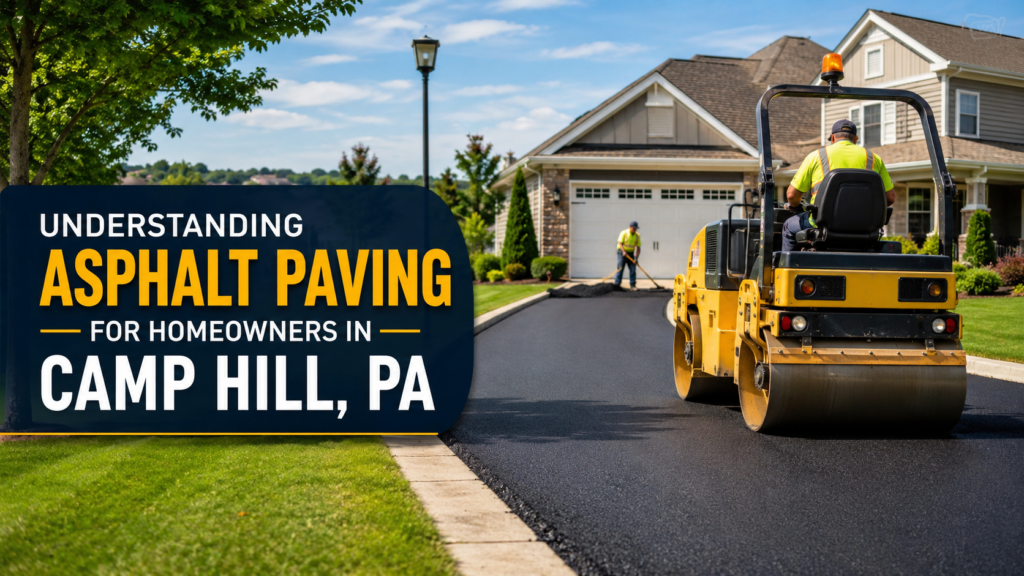
Camp Hill sits just across the Susquehanna River from downtown Harrisburg, and while it shares the capital region’s climate and general geology, it has a distinctly suburban character with tree-lined residential streets, larger lots, and a mix of mid-century and newer homes. For homeowners here, asphalt driveways are one of the most common paved surfaces on a property, and understanding how they age, what causes common problems, and how seasonal weather in central Pennsylvania affects them can help residents plan maintenance more effectively.
This article walks through the general, informational questions that come up most often when Camp Hill homeowners start researching asphalt driveways, from lifespan expectations to the role tree roots and drainage play in a suburban setting.
How Long Does a Residential Asphalt Driveway Typically Last?
One of the most common questions homeowners ask is simply how long a properly installed asphalt driveway should last. With regular maintenance, including periodic sealcoating and prompt crack repair, a residential asphalt driveway generally lasts between fifteen and twenty-five years. Several factors influence where a given driveway falls in that range, including the quality of the base preparation at installation, the thickness of the asphalt layer, drainage conditions, and the amount of vehicle traffic the driveway sees daily.
In a neighborhood like Camp Hill, where many homes have mature landscaping and established trees, root intrusion and shading are two additional variables that can affect a driveway’s lifespan beyond the basics of installation quality and traffic.
The Impact of Trees and Landscaping on Driveway Health
Camp Hill’s tree-lined streets are part of what gives the borough its established, suburban character, but mature trees can also affect nearby pavement. Root systems that grow beneath or alongside a driveway can gradually lift sections of asphalt, creating uneven areas or heaving. This is more likely to happen with certain species that have aggressive, shallow root systems, and it tends to show up gradually over many years rather than suddenly.
Shaded driveways also retain moisture longer after rain or snowmelt than driveways that get consistent sun exposure. That extended dampness can, over time, contribute to a slightly faster breakdown of the asphalt binder in shaded sections compared to sunnier parts of the same driveway.
Seasonal Freeze-Thaw Cycles in Central Pennsylvania
Like the rest of the Harrisburg area, Camp Hill experiences a full four-season climate with winters cold enough to produce repeated freeze-thaw cycles. Water that gets into small surface cracks expands as it freezes, which widens those cracks incrementally each time the temperature drops below freezing and then rises again. This cycle is one of the primary reasons asphalt driveways develop more visible cracking in late winter and early spring than at other times of year.
Homeowners who inspect their driveways each fall, before the coldest weather sets in, and again each spring, have a better chance of catching small cracks and sealing them before they widen significantly over the following winter.
Frequently Asked Questions About Residential Asphalt
How soon after installation can a new driveway be used? Most guidance recommends staying off a freshly paved driveway with vehicles for at least three to five days, and sometimes longer in hot weather, since fresh asphalt needs time to firm up before it can support the weight of a parked car without leaving marks.
Does asphalt need to be sealed right after installation? New asphalt typically needs a curing period of several months to a year before the first sealcoat is applied, since sealing too early can trap oils in the fresh asphalt that need time to evaporate naturally.
What is the difference between a crack and a pothole in terms of urgency? Cracks are generally a maintenance-stage issue that can be filled to prevent water intrusion, while a pothole indicates that the base beneath the surface has already failed in that spot and needs a more involved repair.
Why does my driveway have a slightly different color where it was patched? New asphalt is darker than older, weathered asphalt because sun exposure gradually lightens the surface over years, so a patch will stand out in color until it weathers to match the surrounding area.
Drainage and Grading on Suburban Lots
Because Camp Hill properties often have larger, more varied lots than dense urban blocks, drainage patterns can differ quite a bit from house to house depending on the natural slope of the land. A driveway that is graded correctly directs water away from the garage and foundation, typically toward the street or a designated drainage area, rather than allowing it to pool near the home.
Homeowners who notice water consistently collecting at the bottom of their driveway near the garage, or along one edge of the pavement, are usually seeing a sign that the original grading has settled unevenly over time, which is worth addressing before it leads to more significant water damage.
Routine Maintenance Steps Every Homeowner Can Follow
Basic asphalt maintenance does not require specialized equipment. Keeping the surface clear of leaves and debris, especially in a leafy area like Camp Hill, prevents organic material from trapping moisture against the asphalt. Promptly filling small cracks with a basic crack filler, available at most hardware stores, prevents water from working its way underneath the surface. Avoiding the use of sharp tools like snow shovels with metal edges directly on the asphalt during winter also helps prevent surface gouging.
For larger maintenance tasks like sealcoating or crack repair on a wider scale, many homeowners choose to work with a professional given the specialized equipment and techniques involved in doing the work correctly and evenly across a full driveway surface.
Recognizing When a Driveway Needs More Than Maintenance
While routine care extends a driveway’s life significantly, there comes a point where patching and sealing are no longer enough. Widespread alligator cracking across most of the surface, multiple areas of standing water, or visible unevenness in several spots usually indicates that the base layer beneath the asphalt has weakened significantly, which typically calls for resurfacing or full replacement rather than another round of patchwork repairs.
A knowledgeable asphalt contractor Camp Hill homeowners consult with can generally assess a driveway’s condition and explain which category of work, whether it is a simple patch, a fresh sealcoat, or a more involved resurfacing project, fits the specific situation.
How Home Additions and Landscaping Projects Affect Driveways
Camp Hill homeowners frequently undertake renovation and landscaping projects, from garage additions to new walkways, and these projects can inadvertently affect an existing driveway. Heavy construction equipment driving repeatedly over a driveway not originally built to handle that kind of load can accelerate surface wear or contribute to cracking along the edges, where asphalt is typically thinner and less supported.
Homeowners planning a larger renovation project that will involve heavy equipment access are often well served by having their driveway’s condition assessed beforehand, so that any pre-existing weak spots are identified before added construction traffic potentially makes them worse.
Understanding Driveway Width and Slope Standards
Residential driveways in established neighborhoods like Camp Hill typically follow general standards for width and slope that balance practicality with drainage performance. A driveway that is too flat may not shed water effectively, while one that is too steep can create runoff issues at the bottom near the street or garage. Local zoning and stormwater regulations often factor into these dimensions as well, particularly for any new driveway installation or significant widening project.
Homeowners considering changes to their driveway’s footprint, such as widening it to accommodate a second vehicle, benefit from understanding that slope and drainage planning are just as important as the visible width of the finished surface.
Why Local Climate Knowledge Matters
Asphalt behaves differently depending on regional climate, soil composition, and typical weather patterns, which is why general national guidance about asphalt care is useful background but works best when combined with an understanding of how pavement specifically performs in central Pennsylvania. Camp Hill’s mix of mature landscaping, a full range of seasonal temperature swings, and varied residential lot grading all play into how a driveway ages over time.
Staying informed about these local factors gives homeowners a clearer picture of what to expect from their driveway over the years and helps them plan maintenance at the right intervals rather than waiting until small issues become costly repairs.
How Garage Use and Vehicle Type Affect Wear Patterns
The way a driveway is used day to day plays a role in how evenly it wears over time. Households with multiple vehicles, particularly if one is a larger truck or SUV, tend to see slightly more concentrated wear along the specific tire paths those vehicles travel repeatedly, compared to a driveway used by a single lighter passenger car. Similarly, a driveway that regularly supports a boat trailer, camper, or other heavy equipment experiences more concentrated point loads than one used strictly for everyday commuting vehicles.
This is a useful detail for homeowners to keep in mind when inspecting their own driveway, since wear is rarely perfectly uniform across the full surface and often clusters in predictable areas based on how the space is actually used.